Giacomo Zaganelli. Grand Tourismo

Uffizi Galleries, Florence
July 30, 2018 – February 24, 2019

The Uffizi describes the Uffizi
by Camilla Torracchi (University of Florence)

Near the Statue of Lorenzo the Magnificent, at the entrance to the Uffizi Galleries, the words Grand Tourismo stand out on a green banner. It is the title of the exhibition of artist Giacomo Zaganelli currently open and available until 24 february 2019.

The exhibition, in room 56 of the museum, offers visitors the chance to view three videos by the Florentine artist.

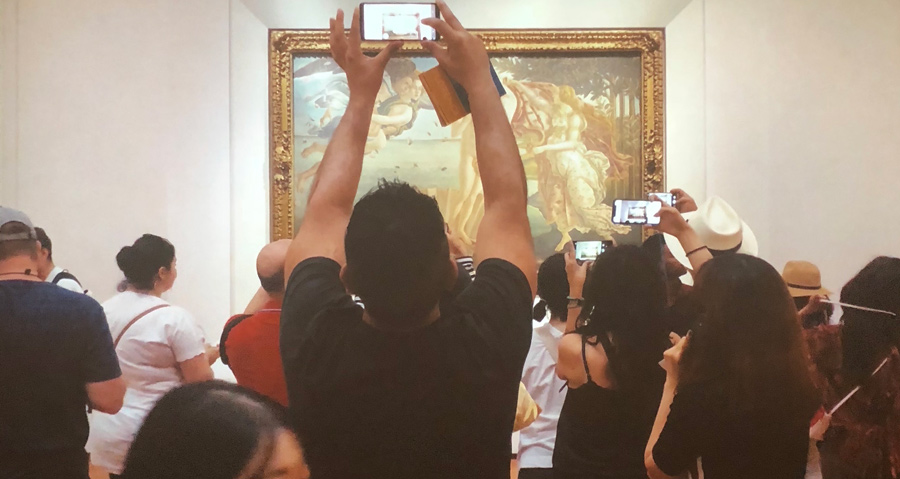
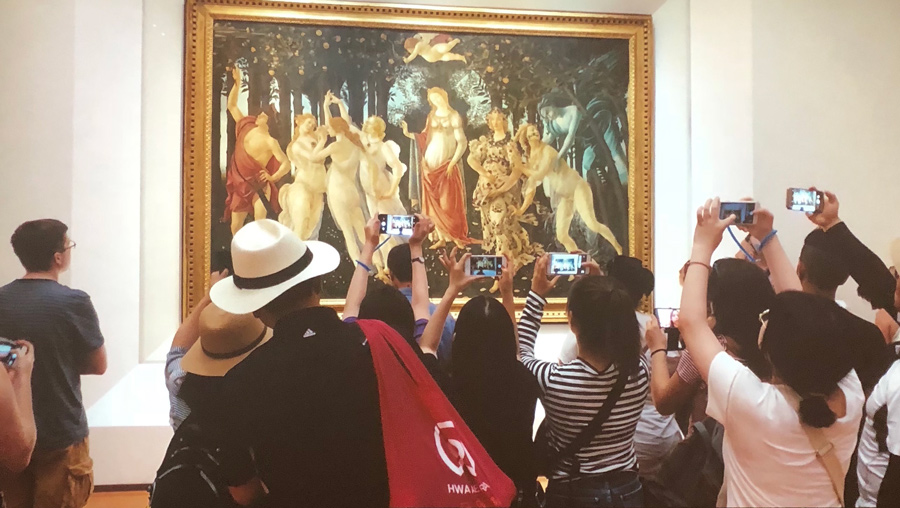
In the first work, Everywhere but nowhere, we are shown a young man sitting behind Palazzo Strozzi in Florence who seems totally alienated from the real world and immersed in virtual reality. In Illusion the streets of the city center of Florence are the protagonists, and are reduced to a background for tourists morbidly taking pictures of the beautiful city. Uffizi Oggi, realized exclusively for the Uffizi Galleries, shows a flood of people amassed in front of Botticelli’s works only long enough to take a picture.

To create the last video, the artist visited the museum on a Sunday with free admission and filmed visitors behaviour in the Botticelli room for three hours. Zaganelli, who I interviewed, explained that he used a smartphone to film so that he would be confused amongst the tourists and remain unobserved.

The video Uffizi Oggi suggests a different way to read the famous masterpieces. Spring and The Birth of Venus have in fact become icons to be observed through the lens of a camera, they seem to no longer exist, transformed into digital images that prove the single visitors presence in the museum so that they can say: ‘I’ve been there, I’ve seen it’.

The exhibition is curated by the director of the Uffizi Eike Schmidt and Chiara Toti and the strong impact of the video is tied to a precise choice of music. At the entrance of the room there is no indication of the presence of the exhibition. Visitors enter the room and are surprised to find a semi-empty room, with irregular white walls and a few benches placed in front of the videos inviting visitors to sit down and reflect with total liberty the break in reality that Zaganelli filmed.

The protagonists of the video are the visitors that we have shared the first part of the visit with, or ourselves, who like looking in a mirror, are shown and recognize our behaviour projected on the wall. Only at the end of the room do we find a panel that allows us to learn the name of the artist and some information about the exhibition.

Grand Tourismo offers visitors the opportunity to question the approach of reality with the invention of devices and the modern way in which we experience and museum and its collection.

The choice of the room is interesting, number 56, which previous held the collection of Hellenistic marbles that today are conserved in the Verone rooms. It is a space that must be crossed in follow the museum visit, and instead of turning the room into a mere place of passage, it was decided that the exhibition should be set up there. In doing so the museum offers all of its visitors the possibility to compare themselves with the artist’s videos, and maybe to continue the visit with less of a filter between themselves and the works.

If on one hand the ban of taking photographs inside museums has brought advantages, on the other it has changed the behaviour of the visitors. As Eike Schmidt, the director of the Uffizi Galleries has said: ‘Starting with a reflection of the entirety of the Uffizi and focusing on the most visited room, where Botticelli’s masterpieces are housed, through the interpretation of Giacomo Zaganelli we wanted to focus on a phenomenon that, changing the relationship between the spectator and the work of art, implies a rethinking of the functions of the museum itself.

The ideal traveller of the Grand Tour is transformed in the artist’s videos in that of Grand Tourismo, a frantic collector of images. The work of art is deprived of its artistic value, as documented by the videos on display, giving us the impression of being in the halls of a museum or on the streets of Florence, but it is only an illusion of being in any place when in reality it is nowhere.

Translation by Marie-Claire Desjardin (Istituto Lorenzo de’ Medici)

Giacomo Zaganelli. Grand Tourismo
Gallerie degli Uffizi, Firenze
30 luglio 2018 – 24 febbraio 2019

Gli Uffizi raccontano gli Uffizi
di Camilla Torracchi (Università degli studi di Firenze)

Vicino la statua di Lorenzo il Magnifico, all’ingresso delle Gallerie degli Uffizi, spicca su un telo verde la scritta Grand Tourismo. Questo è il titolo della mostra dell’artista Giacomo Zaganelli attualmente in corso e visitabile fino al 24 febbraio 2019.
Il percorso espositivo allestito nella Sala 56 del museo propone la visione di tre video  dell’artista fiorentino.
Nel primo lavoro, Everywhere but nowhere, vediamo un ragazzo seduto alle spalle di Palazzo Strozzi di Firenze che sembra alienato dal mondo reale e totalmente immerso in quello virtuale. In Illusion le vie del centro di Firenze sono protagoniste e ridotte a sfondo per turisti che morbosamente si fotografano fra le bellezze della città. Uffizi Oggi, realizzato in esclusiva per le Gallerie degli Uffizi, mostra una fiumana di persone ammassate di fronte alle opere di Botticelli solo il tempo sufficiente per scattare una foto.
Per realizzare quest’ultimo video, l’artista si è recato al museo in una domenica con ingresso gratuito e ha filmato per tre ore il comportamento dei visitatori presenti nella Sala di Botticelli. Zaganelli, da me intervistato, spiega di aver utilizzato per le riprese uno smartphone così da confondersi fra i turisti e passare inosservato.
Il video Uffizi Oggi vuole suggerire un modo diverso di leggere questi famosi capolavori;  La Primavera e la Nascita di Venere infatti sono divenute icone da osservare attraverso il filtro di una fotocamera, sembrano quasi non esistere più, trasformate in immagini digitali che testimoniano la presenza nel museo del singolo visitatore per poter dire: “ci sono stato, l’ho vista”.
La mostra è curata dal direttore delle Gallerie degli Uffizi Eike Schmidt e Chiara Toti e il forte impatto dei video è legato ad una scelta museale precisa.  All’ingresso della sala niente allude a ciò che vi sarà dentro, non ci sono cartelli o pannelli che indichino la presenza della mostra. Si entra nella stanza e si rimane sorpresi in una sala semivuota, con pareti bianche dal profilo irregolare e alcuni divanetti posti di fronte ai video che ci invitano ad accomodarci e a riflettere in totale libertà su spaccati di realtà che Zaganelli ha filmato.
Protagonisti dei video sono i visitatori con cui abbiamo condiviso la prima parte della visita, o noi stessi che, come di fronte ad uno specchio, rivediamo e riconosciamo i nostri comportamenti proiettati sul muro.
Solo al termine della sala troviamo il pannello che ci permette di conoscere il nome dell’artista e alcune informazioni sulla mostra.

Grand Tourismo offre al visitatore la possibilità di interrogarsi sull’approccio al reale con l’avvento dei devices e sul modo con cui oggi si vive un museo e le collezioni che  esso contiene.

Interessante è la scelta della sala, la numero 56, che prima della mostra ospitava la collezione di marmi ellenistici oggi conservati nel Verone. Si tratta di un luogo che è necessario attraversare per proseguire la visita al museo, e invece di trasformare la sala in un mero luogo di passaggio, si è scelto di allestire qui la mostra. In questo modo il museo offre a tutti i suoi visitatori la possibilità di confrontarsi con i video dell’artista, e forse di proseguire la visita con un filtro in meno fra l’uomo e l’opera.

Se da un lato l’abolizione del divieto di fotografare all’interno dei musei ha portato dei  vantaggi, dall’altro ha cambiato il comportamento del pubblico che vi si reca in visita. Come dichiara il direttore delle Gallerie degli Uffizi Eike Schmidt: “partendo da una riflessione intera agli Uffizi e incentrata sulla sala più frequentata, quella dei capolavori di Botticelli, attraverso l’interpretazione di Giacomo Zaganelli abbiamo voluto porre l’attenzione su un fenomeno che, mutando la relazione tra spettatore e opera d’arte, implica un ripensamento delle funzioni del museo stesso”.

L’ideale viaggiatore del Grand Tour  si è trasformato nei video dell’artista in quello del Grand Tourismo, un collezionista frenetico di immagini. L’opera d’arte è privata del suo valore artistico, come documentano i video in mostra, dandoci l’impressione di essere nelle sale di un museo o fra le vie di Firenze, ma è solo l’illusione di essere in qualunque posto e nessun posto realmente.

Photo courtesy Camilla Torracchi
 

Marina Abramović. The Cleaner

Palazzo Strozzi, Florence
September 21, 2018 – January 20, 2019

The process is more important than the result
By Marie-Claire Desjardin (Istituto Lorenzo de’ Medici)

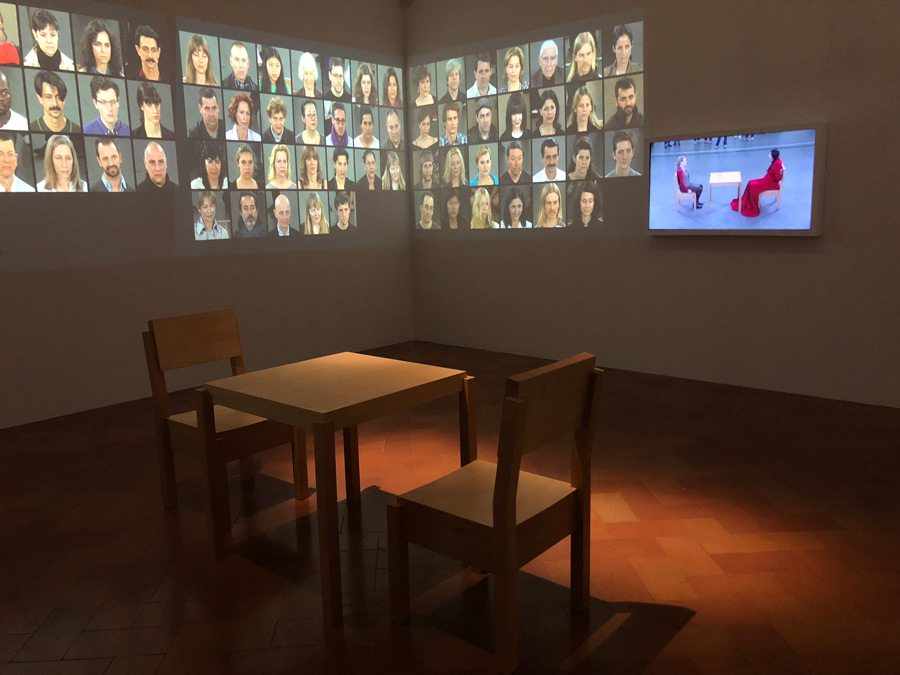
Palazzo Strozzi Foundation presents the first female solo exhibition in their institution, a retrospective of Marina Abramović entitled The Cleaner. Throughout the exploration of Abramović’s five decade long career, the exhibition addresses the issue of the impermanence of performance art, and how to conserve works dependent on the ‘here and now’. Abramović has explored the temporal restraints of her chosen medium in previous retrospectives in the United States, and continues the narrative at Palazzo Strozzi.

‘Reperfomances’ play a key role in the exhibition. Throughout the day a team of performance artists, trained in the strict Abramović method taught in coordination with the artist’s foundation MAI, rotate several of her most recognizable works. The fleeting nature of Performance Art presents an unusual dilemma for a retrospective as the medium itself is transitory. Although the original energy and the artist’s charismatic dedication to her craft could never be reproduced, the solemnity of her apprentices, and their sheer dedication conveyed by physical endurance, creates a doctrinal atmosphere throughout the exhibition.

Many of the reperformances are not done for the entire duration of the foundation’s opening hours, although a schedule is provided electronically in the cortile so that visitors are able to plan around the performances they wish to see. Guided tours are available, but must be pre-booked through the institution. Notably, for 12 days in November ‘The House with the Ocean View’ will be reperformed. This will be the second reperformance of a particularly trying exhibit where an artist will live in across 3 completely open loft-style rooms without eating or speaking for the duration of the performance.

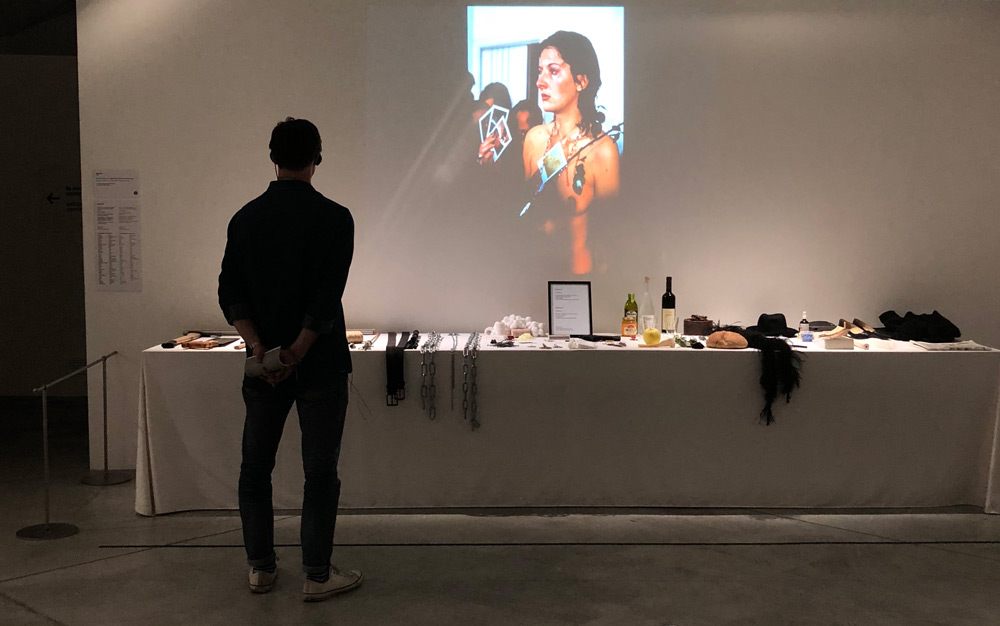
The exhibition itself is composed of reperformances, photographs, videos and objects giving visitors a multisensory experience. The foundation’s wall texts, providing historical information about the performances and Abramović’s life, are accompanied by narrative written by the artist herself. The two act in tandem both informing and personalizing the experience. Participation is actively encouraged, if not necessary, to immerse the visitor in the physicality that is intrinsic for so much of Abramović’s work.

The show itself spans over both levels of the Palazzo Strozzi Foundation, the piano nobile and the lower level in the Strozzina. While the relegation of Abramović’s earlier works to the lower level of the museum may seem counterintuitive, some of the more controversial pieces are displayed in the Strozzina in an effort to create a more inclusive experience on the upper floor. Visitors are warned from the entrance that the recommended age is 14 and above. Aside from nudity, an integral part of Abramović’s vulnerability and interaction with the audience, her work explores the limits of her own physicality through self-harm justifying the suggested age limit.

Since the early stages of her career Abramović has had a close relationship with Italy. Some of her earliest performances took place on the peninsula. ‘Imponderabilia’, repreformed in the first room of the piano nobile of Palazzo Strozzi, presents the artist and her then partner and collaborator Ulay standing naked in the doorway of an entrance of a gallery in Bologna. During the original performance visitors were forced to squeeze through to enter the space. The performance, projected to last 6 hours, lasted only 90 minutes before the police were called and it was shut down. As an introduction to the exhibition, ‘Imponderabilia’ helps to tie the retrospective to Abramović’s early roots in Italy, but also introduces the visitor of the schema of display consistent throughout the exhibition. Visitors can interact with a reperformance, see photos and videos of the 1977 original, and read the historical account of the performance alongside Abramović’s personal recollection of the site specific experience.

Abramović is concerned not only with the preservation and documentation of her own work, but also that of her colleagues. A small portion of the Strozzina displays videos of the artists own reperformances of her contemporaries works in the Guggenheim in 2005. Abramović’s narration through wall texts explains her motivation in recalling the early stages of modern performance art, little of which was documented at the time.

The Cleaner offers visitors not only an exploration into the life and work an intrinsic figure of performance art, but asks viewers to challenge their own beliefs of what constitutes art and what makes art worthy of conservation. The exhibition provides a platform for Abramović to proliferate her longstanding objective in validating the genre of performance art in popular culture while maintaining her narrative challenging the boundaries of the contemporary art scene.


Marina Abramović. The Cleaner

Palazzo Strozzi, Firenze
21 Settembre 2018 – 20 Gennaio 2019

Il processo è più importante del risultato
di Marie-Claire Desjardin (Istituto Lorenzo de’ Medici)

La Fondazione Palazzo Strozzi presenta per la prima volta una mostra dedicata ad una donna, una retrospettiva di Marina Abramović intitolata The Cleaner. Attraverso una disamina della carriera dell’artista durata cinque decenni, la mostra indaga il problema della temporalità della performance art e di come conservare opere che dipendono da un “qui ed ora”.

Abramović ha esplorato i limiti temporali del mezzo con cui ha espresso il suo messaggio artistico nelle precedenti retrospettive negli Stati Uniti e adesso porta avanti questa indagine a Palazzo Strozzi.

Le ‘Reperformances’ giocano un ruolo chiave nella mostra: durante il giorno un gruppo di performers, formati secondo il rigoroso metodo di Ambramović insegnato loro in collaborazione con la fondazione dell’artista MAI, propone in modo alternato molti dei suoi più identificativi lavori. La natura transitoria della Performance Art presenta un particolare problema per la realizzazione di una retrospettiva in quanto il mezzo espressivo scelto dall’artista è esso stesso transitorio. Inoltre l’originale energia e la dedizione carismatica di Abramovic ai suoi lavori non potranno mai essere riprodotte con la stessa solennità dai suoi allievi, e il loro impegno assoluto, rappresentato dalla resistenza fisica, crea un clima didascalico per tutta l’esibizione.

Molte ‘Reperformances’ hanno una durata inferiore rispetto all’orario di apertura della Fondazione, così è fornito un programma elettronico nel cortile in modo che i visitatori abbiano la possibilità di decidere quali performances desiderano vedere. Sono disponibili visite guidate, ma devono essere prenotate tramite la Fondazione. Si segnala che per dodici giorni in Novembre ‘The House with the Ocean Views” sarà presentata come re-performance. Questa sarà la ri-esecuzione di un’esibizione particolarmente complessa nella quale un’artista vivrà in tre stanze completamente aperte senza mangiare o parlare per la durata della performance. La mostra stessa è composta da re-performances, fotografie, video e oggetti che offrono ai visitatori una esperienza multisensoriale.

Le scritte sulle pareti, che forniscono informazioni riguardo le opere e la vita di Marina, sono accompagnate da testi scritti dall’artista stessa e la loro unione fa sì che l’esperienza sia ricca di informazioni e allo stesso tempo personalizzata. La partecipazione è fortemente incoraggiata, se non imposta, per far sì che il visitatore si immerga nella fisicità che è intrinseca in molti lavori dell’artista.

La mostra si estende su tutti i piani della Fondazione Palazzo Strozzi, al piano nobile e al piano inferiore nella Strozzina. Sebbene la collocazione delle opere giovanili dell’artista al piano inferiore possa sembrare illogica, alcune delle opere più controverse sono allestite proprio nella Strozzina nel tentativo di creare un’esperienza più inclusiva al piano superiore. I visitatori sono avvisati che l’ingresso alla mostra è consigliato ad un pubblico maggiore di 14 anni. Oltre alle nudità, parte integrante del concetto della vulnerabilità dell’artista e della sua interazione con il pubblico, il suo lavoro indaga i limiti della sua stessa fisicità attraverso l’autolimitazione, il che giustifica l’età consigliata d’ingresso.

Fin dall’inizio della sua carriera, Marina  ha avuto un rapporto molto stretto con l’Italia. Alcune delle sue prime performances si sono svolte nella penisola. ‘Imponderabilia’, riproposta nella prima stanza del piano nobile di Palazzo Strozzi, vede l’artista e il suo compagno e collaboratore dell’epoca Ulay stare nudi in piedi sulla porta d’ingresso di una galleria di Bologna. Durante la performance originale i visitatori erano costretti a passare attraverso i due artisti per entrare in galleria. Pensata per una durata di 6 ore, la performance durò soltanto 90 minuti prima che la polizia fosse avvisata e la interrompesse. Come inizio della mostra, ‘Imponderabilia’ aiuta a collegare la retrospettiva alle prime esperienze dell’artista in Italia, ma introduce anche il visitatore all’impostazione della mostra che si mantiene coerente per tutto il percorso. I visitatori possono interagire con la re-performance, vedere foto e video originali del 1977, e leggere un resoconto storico della performance insieme alla memoria personale dell’artista di una esperienza site specific.

Abramović non si preoccupa solo della conservazione e della documentazione dei suoi stessi lavori, ma anche di quelli dei suoi colleghi. Una piccola porzione della Strozzina mostra video di re-performances di artisti presentati da Marina al Museo Guggenheim nel 2005.

La storia di Marina illustrata sulle pareti spiega perché si faccia riferimento alle prime forme di performance art, poche delle quali sono state documentate all’epoca dell’esecuzione.

The Cleaner offre ai visitatori non solo una disamina sulla vita e il lavoro di una figura fondamentale della performance art, ma chiede loro di riflettere su ciò che credono sia arte e che cosa rende l’arte degna di essere conservata. La mostra fornisce un’opportunità per Marina per diffondere il suo obiettivo di affermare il genere della performance art nella cultura popolare mantenendo la sua storia e sfidando i limiti del mondo dell’arte contemporanea.


 Traduzione di Camilla Torracchi (Università di Firenze)

Video produced by the Istituto Lorenzo de’ Medici
Photo courtesy Marie-Claire Desjardin