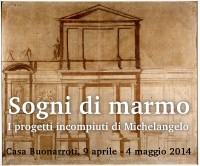
Dreams of Marble: The unfinished works of Michelangelo

By Allison Boyd (Lorenzo de’ Medici)


This exhibition was curated by members of the current Marist-Italy Masters of Museum Studies class, in conjunction with Istituto Lorenzo de’Medici and the Fondazione Casa Buonarroti, and is open until May 4.

The Casa Buonarroti museum, located at Via Ghibellina 70, is currently hosting a special exhibition titled Dreams of Marble: The unfinished works of Michelangelo. The exhibition focuses on the Tomb of Pope Julius II, in Rome, and the façade of the Basilica di San Lorenzo in Florence, both of which were considered to be, in some way, “incomplete”, as well as the demands and difficulties encountered by an artist of Michelangelo’s stature during the Renaissance. Through sketches and architectural designs, as well as documents and contracts, visitors can trace the path of Michelangelo’s creative process on these two projects, while understanding the parts of their development that was out of his hands.

The Tomb of Pope Julius II, once called the “great tragedy” of Michelangelo’s life, was originally conceived as a grand monument to the Pope, and was to be placed in St. Peter’s Basilica in the Vatican. Instead, after 40 years, many revisions of the design, and decreases in scale, a monument to Pope Julius II was erected in the Church of San Pietro in Vincoli. While the façade of the Basilica of San Lorenzo only took up a few years of Michelangelo’s life, those three years were also filled with frustration and ended with an incomplete project. The timeline of these two projects overlapped, with Michelangelo abandoning his work on the Tomb of Pope Julius II in 1517 to begin work on the San Lorenzo façade, and because of this overlap visitors can observe echoes of one project in the sketches and design elements of the other.

The exhibition room is introduced through detailed wall panels, four original documents, including instructions from Michelangelo to the stonemasons at Carrara and a contract between Michelangelo and the heirs of Pope Julius the II, and a quotation from Michelangelo’s writing. One wall contains sketches of the various incarnations of the design for the Tomb of Pope Julius the II, while the opposite wall contains plans for the façade of the Basilica of San Lorenzo. A recto verso sketch that has plans for San Lorenzo on one side and a figure drawing for the Julius II tomb on the other, links these two walls and clearly illustrates the overlap between these two projects.

There are didactic activities for high school students, families, and visitors with intellectual disabilities. All texts, with the exception of the original documents, are in English and Italian.

For more information please visit the website: http://www.casabuonarroti.it/it/2014/04/19/sogni-di-marmo-i-progetti-incompiuti-di-michelangelo/


Sogni di marmo: I progetti incompiuti di Michelangelo

Allison Boyd (Lorenzo de’ Medici)

La mostra, curata dagli studenti dell’attuale master Marist-Italia in Museum studies, con l’aiuto dell’Istituto Lorenzo de’ Medici e della Fondazione Casa Buonarroti, rimarrà aperta fino al 4 maggio e si concentra sia su due opere di Michelangelo rimaste incompiute – la tomba di Giulio II a Roma e la facciata della basilica di San Lorenzo a Firenze – che sulle difficoltà incontrate da un artista della sua statura durante il Rinascimento. Attraverso schizzi, disegni, documenti e contratti il visitatore può ripercorrere il processo creativo che ha portato l’artista allo sviluppo di questi due progetti.

La tomba di Giulio II, una volta chiamata la “grande tragedia” della vita di Michelangelo, fu originariamente concepita come un grande monumento al Papa e doveva essere eretta nella chiesa di San Pietro in Vaticano. Invece, dopo quaranta anni e molte revisioni nella struttura e nella scala, il monumento venne realizzato nella chiesa di San Pietro in Vincoli.

La facciata della chiesa di San Lorenzo impegnò Michelangelo solo per tre anni, pieni di frustrazioni, che diedero alla luce un progetto incompleto.

Le due opere si sovrapposero nel tempo e Michelangelo, nel 1571, abbandonò il progetto per la tomba di Giulio II per dedicarsi a quello fiorentino; i visitatori possono osservare gli echi di un progetto negli schizzi dell’altro.

L’esposizione è introdotta attraverso dettagliati pannelli esplicativi, quattro documenti originali – incluso quello con le istruzioni di Michelangelo ai cavatori di marmo di Carrara e un contratto tra Michelangelo e Giulio II – e una citazione dagli scritti del maestro.

Nella sala una parete è dedicata interamente alla vicenda della tomba di Giulio II mentre quella opposta al progetto per la facciata di San Lorenzo.

Un documento che presenta due diversi disegni sia sul verso che sul recto – uno relativo alla tomba del papa e uno alla chiesa fiorentina – unisce i temi delle le due pareti e illustra chiaramente come questi due progetti si siano sovrapposti nel tempo.

Il museo offre attività didattiche per studenti delle scuole superiori, famiglie e visitatori con disabilità intellettive. Tutti i testi sono sia in italiano che in inglese.

Per maggiori informazioni visitare il sito: http://www.casabuonarroti.it/it/2014/04/19/sogni-di-marmo-i-progetti-incompiuti-di-michelangelo/
Museo di Palazzo Vecchio – Tracce di Firenze. The Wagon of St. John the Baptist: From Pontormo to Cappezzuoli

By Giulia Bagni (University of Florence)

After it closed, in the year 2010, the museum of topographical history, Firenze Com’era, it was situated in the ex-convent Oblate in Via dell’Oriuolo of Florence and the museum is still waiting for a new location. The collection, owned by the Comune consists of many objects of different nature (plastic models, archeological finds, paintings and prints) together illustrate the urban evolution of the city through the centuries from its foundation.

To remedy this situation, Palazzo Vecchio created a small exhibition space next to their ticket office in 2012,Tracce di Firenze, offers to the public a selection of the objects owned by the Firenze Com’era. The space, not very ample but utilizes it well, is subdivided in two sections: a temporary part and a permanent part.

In the first section visitors learn the history of the museum Firenze Com’era thanks to a detailed, but synthetic, description. Curators hope that a new location will be made soon.

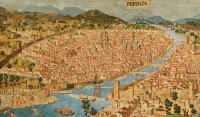
Immediately after, the Pianta della Catena is displayed which is a panoramic prospective of the city of Florence around 1470. It is a reproduction realized in the 19th century from the original that is in Berlin. Thanks to the use of a touch screen that reproduces la pianta, the visitors can touch the churches, streets, squares and the gates of the city walls, and can make a comparison between the ancient Florence and the modern one. Also on the touch screen, information is available for the sites when touched for the visitor to read. It is also possible to make a comparison between la pianta and the map of Florence made by Stefano Buonsignori in the middle of the Cinquecento, which are next to one another.

A chronological jump of two centuries, takes the visitor to sketches with panoramic view of Florence that were realized by Zocchi, as well as paintings with Florence as the subjects that were painted by Florentine masters and strangers with the preferred subject of Lungarni fiorentini.

It was necessary to have a small space dedicated to the Risanamenti (renewal) of the end of the 19tu century in area of the mercato Vecchio, which is now Piazza della Repubblica. Thanks to another touch screen it is possible to interact with the small sketches of the mercato Vecchio hanging above, and through the use of the touch screen the visitor can be referred to the individual sketches and acquire more information.

Surprisingly, a large panoramic image of the city that includes the surrounding Florentine hills was made by hand (with paper and ink) by a German architect in 1936.

At the end of the pathway, two paintings remind the visitor of two of the most tragic moments faced by the city: the destruction of World War II and the flood of 1966.

The temporary section, for the occasion of the exhibit in Palazzo Strozzi that is dedicated to Pontormo and Rosso Fiorentino, holds a small exhibit focused on the Carro di San Giovanni or della Zecca Vecchia. It was decorated in part, in 1514, by Pontormo and 13 paintings by Pontormo also survive. The cart was paraded through the city during the celebration of the Festa degli Omaggi, and it was torn apart in the 19th century. Curators decided to display these paintings with surviving sculptures that decorated the cart. The story of the celebration and of the cart are illustrated through a video that shows iconographic examples and virtual reconstructions. Unfortunately, because of the limited space, there are no seats and if more than one visitors stop to watch the video they impede on the pathway’s space.

In conclusion, notwithstanding the limited space, the curators were able to highlight the importance of these objects and were also able to construct a logical pathway that illustrates all of the important events of the city. Thanks to the use of multimedia instruments, the narration involves actively the visitors and also stimulates the public to create a comparison between the ancient city and the modern one.

This is a good start in thinking of a new setting for the entire collection of the Firenze Com’era.

The entrance is free and all of the text, including the text on the touch screens, is available in both English and Italian.

For more information, please visit the website:

Http://museicivicifiorentini.comune.fi.it/palazzovecchio/evento41.htm

http://museicivicifiorentini.comune.fi.it/export/sites/museicivici/materiali/San_Giovanni_Pontormo.pdf


Museo di Palazzo Vecchio – Tracce di Firenze

Giulia Bagni (Università di Firenze)

Dopo la chiusura, avvenuta nel 2010, del museo storico topografico Firenze com’era, situato nell’ex convento delle Oblate in via dell’Oriuolo a Firenze, l’interessante raccolta che lo costituiva (di proprietà comunale) è ancora in attesa di una nuova ed adeguata collocazione. Essa consisteva in un insieme eterogeneo di oggetti (plastici, reperti archeologici, dipinti e stampe) volti ad illustrare l’evoluzione urbanistica della città attraverso i secoli, a partire dalla sua fondazione.

Per rimediare a questa situazione, accanto alla biglietteria del museo di Palazzo Vecchio, nel 2012 è stato inaugurato uno spazio – Tracce di Firenze – che ripropone all’attenzione del pubblico una selezione degli oggetti appartenenti al museo.

Lo spazio, non molto ampio ma ben sfruttato, è stato suddiviso in due sezioni: una temporanea e l’altra permanente.

Nella prima sezione il visitatore conosce la storia del museo Firenze com’era grazie ad una dettagliata, ma allo stesso tempo sintetica, descrizione; istituzione che si auspica abbia presto una consona e più ampia sede.

Subito dopo è esposta la cosiddetta Pianta della catena, una veduta prospettica della città di Firenze intorno al 1470. Si tratta di una riproduzione eseguita nel XIX secolo dall’originale che si trova a Berlino. Grazie ad uno schermo touch screen che riproduce la pianta il visitatore, toccando alcune chiese, piazze e porte della mura della città, può fare un raffronto tra la Firenze antica e quella attuale, il tutto accompagnato da brevi cenni storici. Inoltre è possibile fare un confronto con la pianta, sempre di Firenze, realizzata da Stefano Buonsignori alla metà del Cinquecento, esposta proprio lì accanto.

Con un salto cronologico di ben due secoli, si giunge alle stampe con vedute di Firenze realizzate dallo Zocchi e da dipinti che hanno come soggetto sempre la città, opera di maestri fiorentini e stranieri che si soffermano soprattutto sulla raffigurazione dei Lungarni fiorentini.

Non poteva mancare un piccolo spazio dedicato ai Risanamenti avvenuti alla fine dell’Ottocento nella zona del mercato Vecchio, l’attuale area di Piazza della Repubblica. Grazie ad un altro schermo touch è possibile individuare su una pianta della città, che indica i cambiamenti avvenuti nei secoli nell’area, i punti a cui corrispondono i piccoli scorci realizzati dal pittore Antonio Marrani prima delle demolizioni.

Stupefacente una grande veduta panoramica della città che si estende anche alle colline, realizzata a mano (carta su inchiostro) da un architetto tedesco nel 1936.

A concludere il percorso, due opere pittoriche che ricordano i due momenti più tragici vissuti dalla città: le distruzioni belliche della seconda guerra mondiale e l’alluvione del 1966.

La sezione temporanea invece, in occasione della rassegna a Palazzo Strozzi dedicata a Pontormo e Rosso fiorentino, ospita una piccola mostra incentrata sul carro di San Giovanni o della Zecca, alla cui realizzazione partecipò, nel 1514, il Pontormo e di cui rimangono ben 13 tavole. Il carro, che veniva fatto sfilare in occasione della festa degli Omaggi, venne smantellato nell’ottocento, e qui vengono riproposti, oltre alle suddette tavole, anche alcuni apparati scultorei che lo adornavano.

Tutta la storia della festa e le vicende del carro, sono ripercorse grazie ad un video che propone testimonianze iconografiche e ricostruzioni virtuali. Purtroppo, a causa dello spazio limitato, non ci sono sedute e se più di un visitatore si ferma a guardare il video questi impediscono agli altri il passaggio e la visione delle opere esposte.

In conclusione, malgrado lo spazio ristretto, i curatori hanno saputo valorizzare gli oggetti esposti e costruire un percorso logico, nonostante i salti temporali, che toccasse tutti gli avvenimenti più importanti che hanno riguardati la città nei suoi cambiamenti urbanistici.

Grazie all’uso di strumenti multimediali la narrazione coinvolge attivamente il pubblico e lo stimola a creare continui confronti con la forma attuale della città.

Si tratta dunque di un buon inizio da cui partire per pensare ad un nuovo allestimento in grado di esporre tutta la collezione posseduta dal comune.

L’ingresso è gratuito e tutti i testi, compresi quelli degli schermi touch e del video, sono sia in italiano che in inglese.

Per maggiori informazioni visitare i siti web: http://museicivicifiorentini.comune.fi.it/palazzovecchio/evento41.htmhttp://museicivicifiorentini.comune.fi.it/export/sites/museicivici/materiali/San_Giovanni_Pontormo.pdf

Family Matters: Portraits and experiences of Family today

By Daniela Quadrelli (University of Florence)


Ending on the 20th of July it is possible to visit the exhibition Family Matters in the Centro di Cultura Comtempranea di Firenze, CCC Strozzina, situated in the basement of Palazzo Strozzi. The CCC Strozzina is distinguished by its difference from the other expositions in Florence because it is one of the only spaces dedicated to contemporary art. The exhibits, mostly organized by the curators and the director of the center Franziska Nori, the exhibit focuses on the aspect of contemporaneity. After An Idea of Beauty and Unstable Territory, the two previous exhibits, which represented the beauty and the instability of the concepts of territory, the center proposes another big challenge considering family.

These 11 works by contemporary artists, which include photographs, instillations, and videos, serve as a starting point in the investigation of the family today. Among the most compelling works, is the reconstruction of a home environment: a living room. There is a couch with a stereo next to it, a recliner with a telephone, a side table with a radio and a dining room table. All of the furniture invite the visitors to sit down and listen. In fact, every radio, stereo and telephone are on and emit a repeated monolog of the fathers, mothers, and children who tell their relationships. Sitting down comfortably the visitor becomes part of the artwork, contributing to the artwork, and enter in a sort of psychological analysis.

Between the photographic works emerges a Chinese artist John Clang, who represents a characteristic aspect of the contemporary man: the separation of the familiar affections that happens when a member of the family moves to another country. The reunification happens only virtually, for example projecting the image of the parents next to the emigrated child.

The most deserving work, for the simplest communication and for the affinity with the subject of the exhibit, isMother Tongue by Chrisha Oswald. The video refers to the native language and to the gesture that the mother makes to her child and vice versa: licking their faces. The video is shocking but it offers an interesting point of reflection about the way that we can express affection. This is not an acceptable gesture for men but for animals is a demonstration of affection and tranquility. The cancellation of this taboo could make us able to feel more liberated to express our individuality.

Some art works are less stimulating, and others are less clear so the reading of labels and explanation panels are necessary instruments to understand. The setting is effective starting from the entrance where an introductory panel explains the purpose of the exhibit. Every room is dedicated to one art work, or one artist, so it permits a good fruition of the videos and the audio areas so they do not interfere with one another.

As usual for this kind of exposition organized by the Strozzina, a specific section makes the visitors active and participants. In fact at the end of the pathway there are books that make you think about the topic at hand: family. Next to this small library there are three screens on a repetitive loop with theme songs of the TV series for the ’60’s to the 2000’s that help the visitors to understand the image of the family and the stereotypes are changing through time.

There are activities every Thursday at the CCC Strozzina, meetings to examine in depth the theme that is represented and the work that is displayed. Every Thursday it is possible to visit the exhibit for free from 6PM to 11PM, this causes a large crowd, and the quality of the visit is affected.

For more information please visit the website: http://www.strozzina.org/en/exhibitions/questioni-di-famiglia/


Questioni di famiglia. Vivere e rappresentare la famiglia oggi

Daniela Quadrelli (Università di Firenze)

Fino al 20 Luglio è possibile visitare la mostra Questioni di Famiglia al Centro di Cultura Contemporanea di Firenze, CCC Strozzina, situato nei sotterranei di Palazzo Strozzi.

Il CCC Strozzina si distingue dalle altre realtà espositive fiorentine poiché è uno dei pochi luoghi dedicato all’arte contemporanea. Le mostre, organizzate per lo più dalla curatrice e direttrice del centro Franziska Nori, si focalizzano su aspetti della contemporaneità. Dopo Un’idea di bellezza e Territori instabili – le due precedenti mostre che hanno provato a rappresentare la bellezza e l’instabilità dei concetti di territorio, confine e identità – il centro si pone un’altra sfida ambiziosa, prendendo in esame la famiglia.

Si tratta di 11 opere di artisti contemporanei, tra cui fotografie, video e installazioni, che servono come spunto per un’indagine sulla famiglia odierna.

Tra le opere più coinvolgenti vi è la ricostruzione di un ambiente domestico: un salotto. Qui si trovano un divano con accanto uno stereo, una poltrona con telefono fisso, un tavolinetto con radio e un tavolo da pranzo. Tutti gli arredi invitano lo visitatore a sedersi ed ascoltare. Infatti ciascun dispositivo fonico è acceso e manda in ripetizione monologhi di padri, madri e figli che raccontano le reciproche relazioni. Seduti comodamente su una poltrona diventiamo parte dell’opera, parziali autori ed allo stesso tempo siamo invitati ad entrare in una sorta di luogo di “autoanalisi”.

Tra le opere fotografiche emergono quelle del cinese John Clang che riesce a cogliere un aspetto caratteristico dell’uomo contemporaneo, ovvero il distacco dagli affetti familiari quando un membro si ritrova a vivere in un altro paese. La riunificazione avviene solo virtualmente, per esempio proiettando l’immagine dei genitori accanto al figlio emigrato.

L’opera più meritevole, sia per la semplicità comunicativa che per l’affinità con la tematica espositiva, è Mother Tongue di Chrisha Oswald. Il video, dal titolo traducibile in “lingua madre”, allude al linguaggio di comunicazione nativo e al gesto che la madre compie verso la figlia e viceversa: leccare il viso. Se da un lato la scena si mostra destabilizzante, ci offre un interessante spunto di riflessione sulle modalità di esprimere affetto. Questo è un gesto inaccettabile per l’uomo ma per gli animali una dimostrazione di affetto e di tranquillità. In un’ottica di apertura mentale la cancellazione di questo come di altri tabù ci permetterebbe di sentirci più liberi di esprimere la nostra individualità.

Nel complesso alcune opere si mostrano poco stimolanti ed altre poco chiare per cui la lettura delle didascalie e dei pannelli esplicativi, risultano strumenti necessari. L’allestimento risulta efficacie a partire dall’ingresso in cui un pannello introduttivo spiega gli intenti della mostra fino alle disposizione delle luci. Anche la modalità di organizzazione spaziale, dove ogni sala è riservata ad una sola opera o ad un solo artista, permette un dosaggio calibrato delle informazioni e garantisce un’ottima fruizione degli audio e dei video che non si disturbano a vicenda.

Come spesso accade nelle esposizioni organizzate dalla Strozzina, una sezione apposita rende il pubblico attivo e partecipe. Infatti alla fine del percorso sono presenti una serie di libri in consultazione che invitano a riflettere sul tema della mostra. Accanto alla piccola biblioteca vi sono tre monitor che mandano in loop le sigle delle serie televisive trasmesse dagli anni Sessanta fino al Duemila, per osservare come è cambiata nel tempo “l’immagine” della famiglia ed i suoi stereotipi.

Tra le attività si segnalano I giovedì alla CCC Strozzina, un ciclo di incontri che ad ogni mostra si ripresentano come un valido strumento per approfondire temi ed opere esposte. Sempre il giovedì è possibile visitare la mostra gratuitamente dalle 18 alle 23 anche se, a causa del sovraffollamento, la qualità della visita ne risente.

Per maggiori informazioni visitare il sito: http://www.strozzina.org/exhibitions/questioni-di-famiglia/